
Understanding how armed groups factor into conflict prevention
Should we view armed groups solely as a threat?
More than 200 million people live under their authority or influence worldwide. Our new typology identifies how armed groups differ, and what that means for conflict prevention.
The Four Cs
Armed groups are not interchangeable.
Some complement state authority,
some co-exist alongside it,
and others substitute for it.
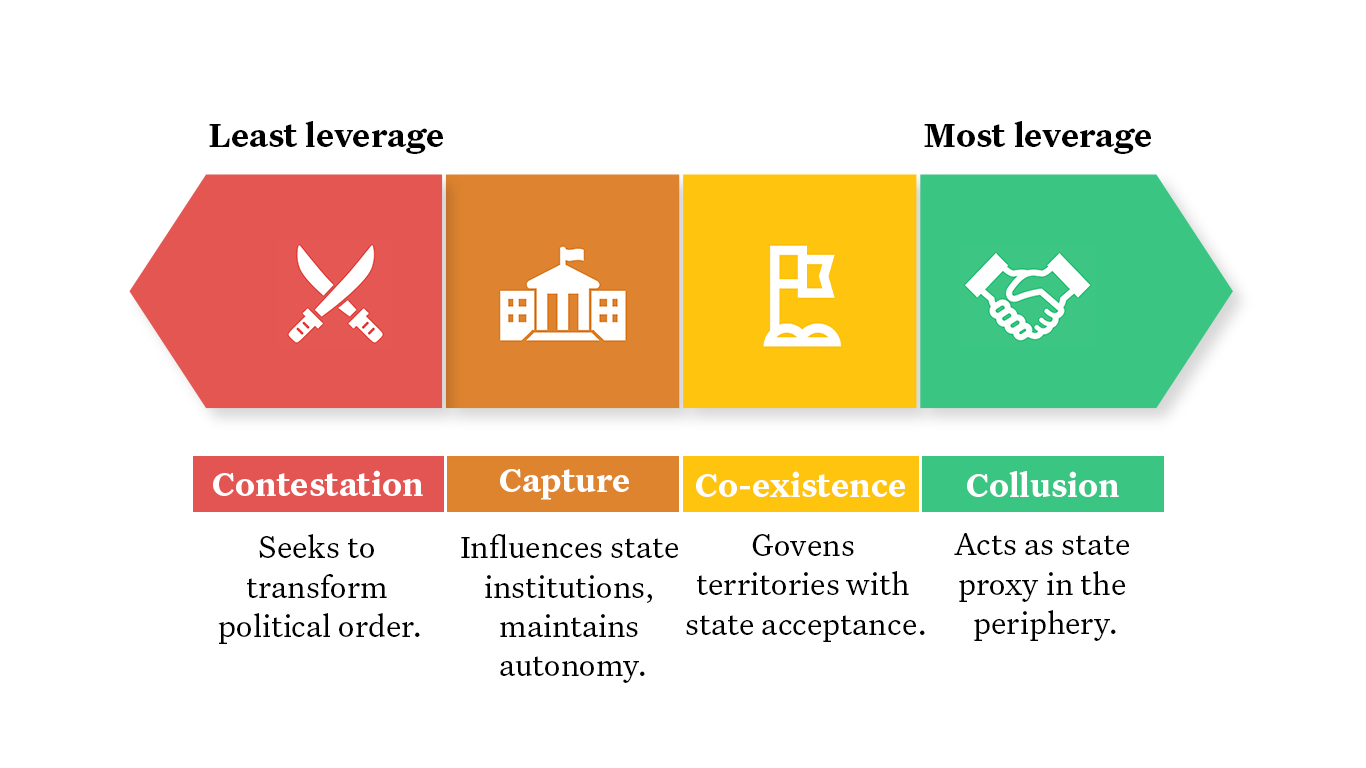
Contestation
Type 1a: Challenge state authority and seek to replace or reshape existing political order.
Type 1b: Contest the host state’s authority with the support of, or on behalf of, third states.
Type 1c: Contest the state’s authority primarily to enable and protect illicit activities.
Country example
Yemen
Today, Ansar Allah (known as the Houthis) act as the de facto government in the north, while the internationally recognised government (IRG) retains tenuous control over parts of the south.

Capture
Armed groups and state institutions become intertwined, with armed groups exerting influence over parts of the state while retaining operational autonomy and territorial control.
Country example
Lebanon
Hezbollah has secured significant influence within the Lebanese state through representation in parliament, government, and local authorities.
At the same time, it retains an independent military structure that operates outside the control of the Lebanese Armed Forces (LAF).
Co-existence
Armed groups evolve into territorially based governing authorities, exercising de facto or formally recognised control over discrete territories.
Country example
Iraqi Kurdistan
The Kurdistan Region of Iraq (KRI) emerged after Kurdish armed groups consolidated territorial control and established de facto self-rule in northern Iraq.
Its autonomy was formalised in the 2005 Iraqi constitution, which recognised the KRI as a federal region with its own parliament and security forces.

Collusion
Armed groups cooperate with the state and act as informal state proxies in peripheral areas.
Country example
South Sudan
The government of President Salva Kiir has used local ethnic militias as proxies to weaken political and military rivals, providing them with arms, funding, and logistical support.
Opposition groups have at times pursued similar strategies. Because these militias remained outside formal command structures, the degree of control exercised by their sponsors varied across groups and over time.

Our typology can help prevention actors navigate complex armed group contexts.
Our prevention lead
Albert Souza Mülli
Head of Policy Advice, Centre on Armed Groups
Albert has over 17 years of experience in conflict resolution and mediation, stabilisation and peacebuilding policy and programming.