
Ashley Jackson

Ashley Jackson
Co-Director
Email: jackson@armedgroupscentre.org
Ashley is co-director of the Centre. Her work on understanding and engaging armed actors draws on nearly two decades of research and operational experience in conflict and humanitarian settings. She began her career as an aid worker in Southeast Asia and Afghanistan with Oxfam, the International Red Cross and Red Crescent Movement, and the UN. She has since advised governments, UN agencies and NGOs, including as an adviser to the UK Parliament, the UN Secretary-General’s Office, and the US Special Representative for Afghanistan during the Doha talks.
She is the author of Negotiating Survival: Civilian–Insurgent Relations in Afghanistan (Hurst/Oxford University Press, 2021), which examines civilian agency and life under Taliban rule. She is also co-author of two forthcoming books: Al-Shabaab Reconsidered: Power, Politics and Survival in Somalia (African Arguments/Hurst, with Mohamed Mubarak) and A Guide to Armed Groups (Columbia University Press, with Centre Co-Director Florian Weigand).
Ashley’s analysis has appeared in Foreign Policy, the New York Times, the Washington Post, Al Jazeera and Politico, among other outlets. She holds a PhD in War Studies from King’s College London and an MSc in Gender and Development from the London School of Economics. She is also an affiliated researcher at the Centre for Conflict, Development and Peacebuilding at the Geneva Graduate Institute (IHEID) and the Conflict, Security & Development Research Group at King’s College London.
She is originally from New York, but currently resides in Dar es Salaam.
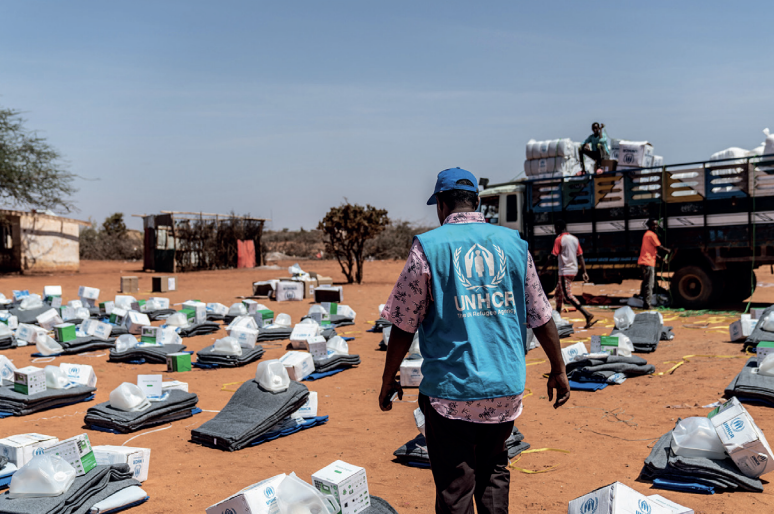
Although the aid sector often treats corruption and diversion as an anomaly, they are pervasive, systemic and often unwittingly perpetuated by standard aid sector practices. Drawing primarily on evidence from Somalia and Afghanistan (with reference to other contexts), this paper explores the specific aid practices that enable and perpetuate corruption and diversion, and what donors and implementers should be doing differently.
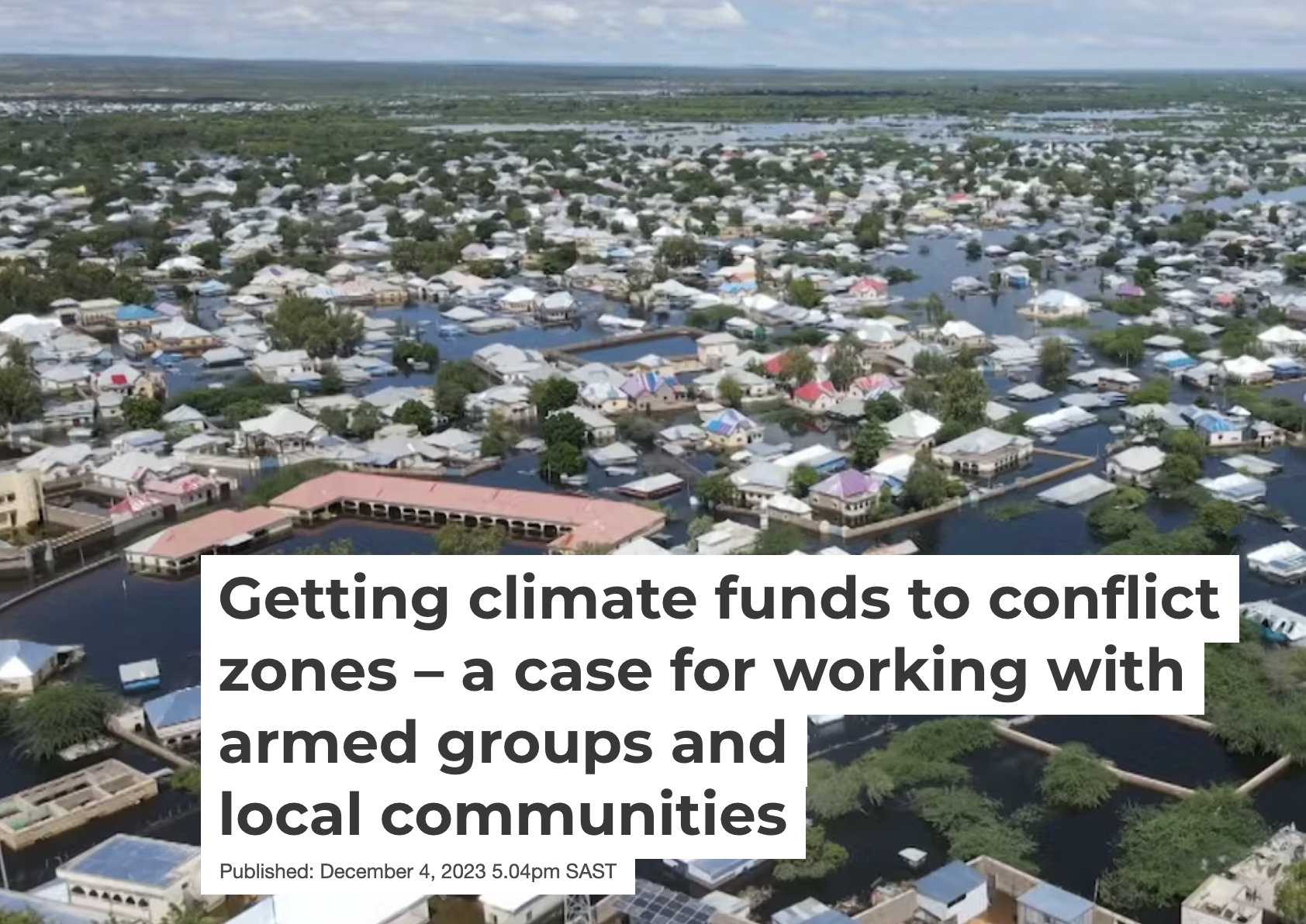
Conflict-ridden and fragile countries are among the most vulnerable to climate change and least prepared to deal with it. They are largely excluded from climate adaptation programmes and funding. This article charts a path forward on how to address climate adaptation in conflict zones.

This paper examines climate change and armed groups, specifically the failure the address climate adaptation in areas beyond state control.

This rapid analysis look at the impact of the the Israel-Hamas war on the behaviour of armed groups, and constraints on engaging with them.

Based on extensive research in Al-Shabab controlled areas of Somalia, this paper explores dynamics between Al-Shabab and those who live under their control.

This paper argues that we should not see ‘political’ and ‘criminal’ groups as separate categories. Instead, we should envision a spectrum of motives and practices across all armed groups, regardless of how they are labelled.

This paper argues that we should not see ‘political’ and ‘criminal’ groups as separate categories. Instead, we should envision a spectrum of motives and practices across all armed groups, regardless of how they are labelled.

This joint paper with ODI explores what we know (and what we don’t) about how ordinary people engage with armed groups.
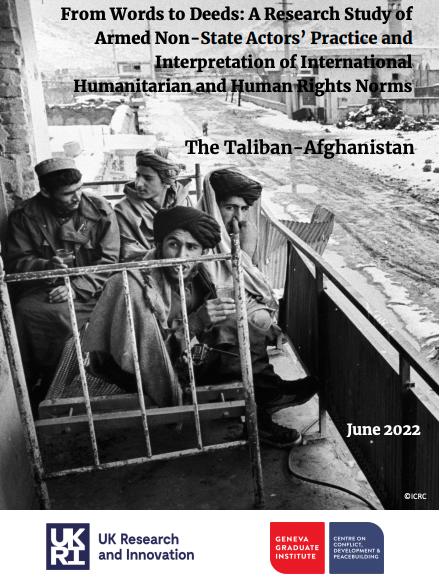
Part of a larger research programme hosted by the Geneva Graduate Institute, this study examines the Taliban insurgency’s practice and attitudes toward IHL rules and human rights norms.

Prevailing understandings of control – which focus on territorial dividing lines and acts of violence – are incomplete. Our paper argues that armed group control should instead be broken down according to how armed groups seek to influence populations.
Based on a review of armed group taxation practices, this journal article argues that armed group motives go beyond revenue. It explores explanations related to ideology, legitimacy, institution building, control of populations, and the performance of public authority.
Surveying the existing literature, this ICTD Working Paper argues that a deeper understanding of armed group taxation, the motivations behind it, and the implications it has for an armed group’s relationship with civilian and diaspora populations, as well as the broader international community.

Much has been written about the Taliban and Al Qaeda since 2001, but there is little consensus. Based on over 100 interviews with insurgent commanders and others, this report examines the Taliban’s strategic calculus for maintaining ties to Al Qaeda.
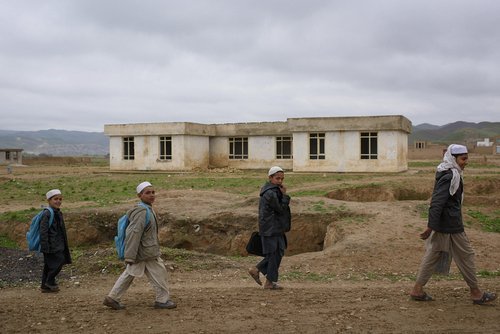
There are significant debates and differences of opinion within the Taliban on education. Based on original documents and interviews, our paper explores written Taliban policy on education, and practice on the ground.

Seizing on widespread dissatisfaction with formal justice, Taliban courts quickly settled disputes that the state and customary institutions could not. It also enabled the Taliban to infiltrate new areas and enforce a strict set of rules on the population.