
Afghanistan: the collapse of the roadblock state
This paper by David Mansfield examines how control over Afghanistan’s roadblocks and border crossings shaped the political economy of the Afghan Republic and contributed to its collapse in 2021. It shows how the country’s extensive trade routes became sources of revenue and patronage for government officials, provincial powerholders and the Taliban, with control over strategic points along major highways often more important than control over territory. Drawing on more than 1,200 interviews, high-resolution satellite imagery and geospatial data, the paper maps trade flows and estimates the revenues generated at key roadblocks. It challenges the emphasis on drugs and minerals in accounts of Taliban financing, showing that taxation of everyday goods transported along Afghanistan’s main roads generated substantial revenues.
Checkpoint governance in South Sudan
This paper by Joshua Craze and Ferenc Dávid Markó examines the role of checkpoints in South Sudan’s political economy, challenging the view that they are simply obstacles to trade, humanitarian access and state reform. It argues that checkpoints are a central form of state authority in a country where government salaries and public services are limited, oil revenues have declined and humanitarian funding is increasingly uncertain. The paper shows that rather than representing state failure, checkpoints reflect the longstanding predatory character of state power in South Sudan, with communities themselves sometimes adopting similar systems to resist elite extraction.
This paper is the 16th in a working paper series on Roadblocks and Revenues, a collaboration between the Danish Institute for International Studies, the International Centre for Tax and Development and the Centre on Armed Groups.

Checkpoint Fragments and Hierarchies: Competing regimes of circulation in wartime Yemen, 2015-2026
Yemen’s war is also fought through roads. This paper shows how checkpoints along the Abyan–Aden–Lahej–al-Dhale’a–Dhamar corridor have become tools for extracting money, sorting people and goods, and enforcing rival claims to authority. It contrasts fragmented checkpoint rule in government/STC areas with the more centralised Houthi system, while showing that both make movement costly and politically controlled.

A Fracturing Order
This discussion paper examines how the international order that once contained armed conflict is fracturing across multiple, simultaneous dimensions. Drawing on cases spanning Sudan, Myanmar, Yemen, the Sahel, and Ukraine, the paper argues that these compounding failures have given armed groups and de facto authorities far greater freedom and resources than most analysts anticipated.
The paper identifies four cross-cutting dynamics reshaping this landscape: the breakdown of the classic patron-proxy model into fragmented, multi-patron brokerage networks; the growing economic and infrastructural power of armed groups, who now govern revenue streams, trade routes, and services independent of external backers; the retreat of international norm enforcement in favour of local, informal bargaining; and the weaponisation of misinformation to derail negotiations and access agreements. On this basis, the paper calls for a fundamental shift in how donors and practitioners approach engagement.

Governing routes across the contested Sahara: Checkpoints and the political economy of trans-Saharan trade around Kufrah
What kind of authority is built at a desert checkpoint? This paper examines how control over movement around Kufrah, in southeastern Libya near the borders with Sudan and Chad, turns checkpoints into institutions of rule, where armed actors tax passage, define legitimate trade, exclude rivals, and shape the logistics of regional war.

Checkpoints, conflict and scam logistics: Mobile control and the politics of circulation in the China-Myanmar-Thailand borderlands
How do checkpoints shape online scam economies? This paper examines how control over border crossings, roadblocks, and gateways sustains scam centres in Myanmar’s borderlands and shapes the uneven effects of anti-scam enforcement.

Checkpoints, transport, networks and armed conflict
Why are some checkpoints more violent than others? This paper examines how control over key transport routes shapes violence in conflict zones and affects civilian populations.

War over Checkpoints: Nine theses on roadblocks and the politics of circulation in conflict-affected borderlands
Drawing on research in Chad, DR Congo, Libya, Myanmar, South Sudan, West Africa and Yemen, this Working Paper challenges narrow readings of roadblocks as security devices or sites of corruption. Instead, it conceptualises them as politically and economically generative nodes through which authority is exercised, rents are extracted and redistributed, markets are shaped, and conflict is financed.

Armed Group Economic Policy: Towards a New Research Agenda
From Myanmar to Somalia, armed groups are shaping markets, setting economic rules, and pursuing international economic relations. This report challenges the narrow focus on illicit finance, showing how armed groups around the world regulate trade, allocate resources, and govern everyday economic life—sometimes more effectively than the state. Combining insights into four case studies and a comparative analytical framework, the report offers a new lens for understanding how non-state actors structure economies during conflict. For development economists, peacebuilders, and humanitarians, understanding these systems is essential. Effective aid, realistic economic policy, and meaningful engagement with conflict-affected areas all require a grounded view of how armed groups govern economies in practice.
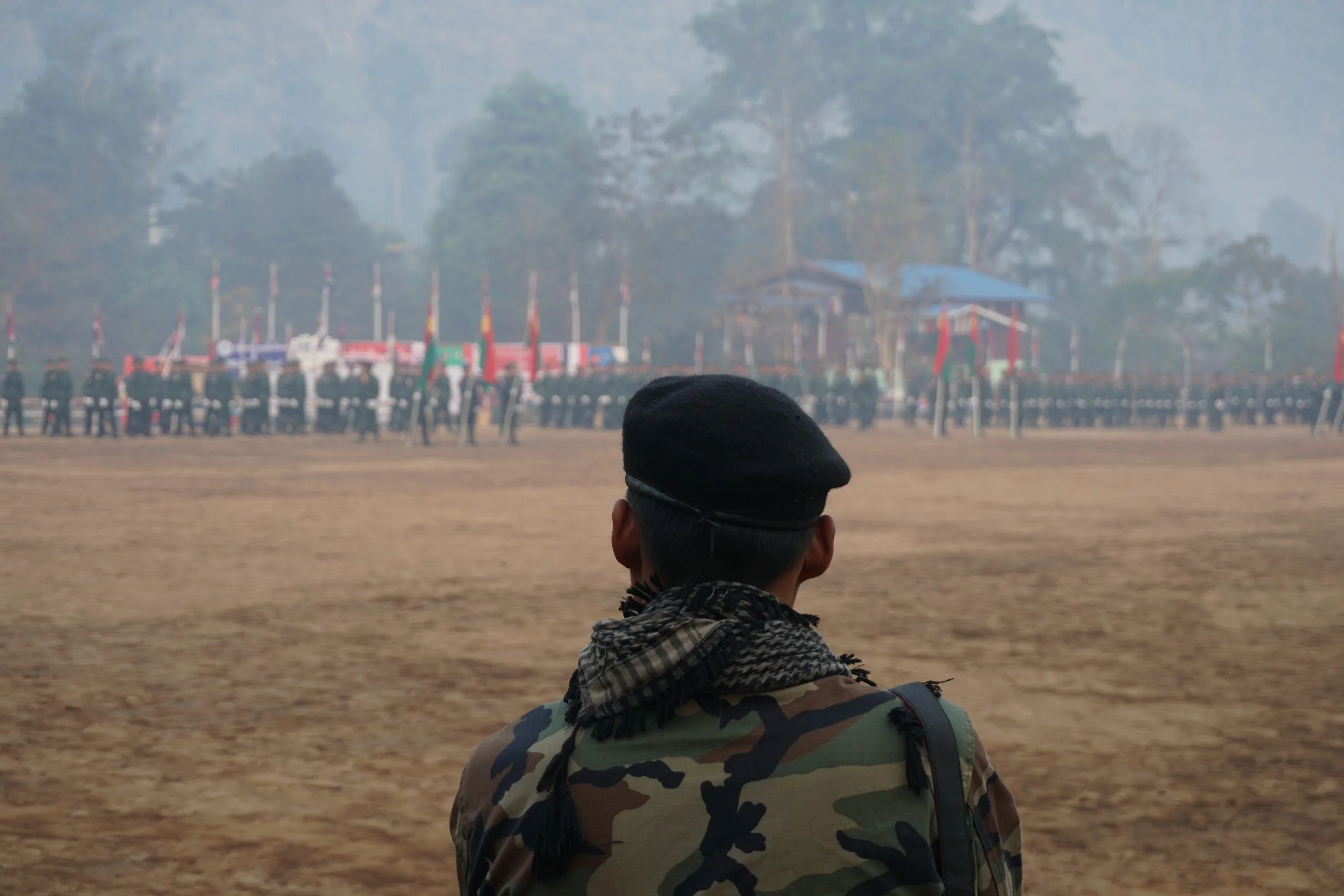
Funding the People's Defence Forces in Myanmar
This report examines how Myanmar’s anti-coup resistance movement is being financed, offering a comprehensive analysis of how the People’s Defence Forces (PDFs) sustain themselves economically. Drawing on dozens of interviews with resistance actors, civil society, and international stakeholders, it sheds light on the diverse fundraising methods, ranging from crowdfunding to natural resource taxation, and explores how these practices are reshaping local governance, political legitimacy, and the broader trajectory of Myanmar’s war. The report confronts complex dilemmas around accountability, aid diversion, and international support, offering critical practical and operational insights.