
Iraq's PMF integration paradox: competing visions for a future within the Iraqi state
Inna Rudolf
July 2026
Twelve years after its creation, Iraq’s Popular Mobilisation Forces (PMF) sits at the centre of the country’s security, political, and welfare architecture. This means that DDR, currently the subject of renewed debate, presents a distinct challenge. Many of the PMF’s constituent armed groups are willing to accept disarmament, but on differing terms, including their degree of commitment to wider resistance networks.
In this expert comment, Dr Inna Rudolf argues that reform proposals should not treat the PMF only as a security actor and should look towards gradual reform of PMF governance structures.
On 14 June 2026, supporters of Iraq’s PMF marked the twelfth anniversary of Grand Ayatollah Ali al-Sistani's fatwa mobilising Iraqis against the Islamic State. The mobilisation gave rise to the PMF, an umbrella organisation of predominantly Shi'a armed groups that, alongside the Iraqi security forces, played a central role in the campaign against ISIS. Twelve years after its creation, the PMF occupies a central position in Iraq's security, political, and economic order. Yet, growing pressure to disarm the Iran-aligned resistance factions and reform the PMF has revived the debate over the paramilitary’s status within the Iraqi state.
While PMF leaders increasingly present the organisation as a national institution and a legitimate pillar of the state security architecture, international actors continue to call for stronger state control over the armed resistance factions operating under its umbrella. Several of these factions maintain close ties with Iran and allied armed groups across the region. Against this backdrop, an important debate has emerged over their future. While some increasingly regard sustained integration within the PMF as a way to preserve and institutionalise their influence, others remain wary that continued membership in a reformed institution could come at the expense of their resistance fighter credentials and limit their operational autonomy.
“Electoral success converts battlefield legitimacy into bargaining power within the state”
Sudani's attempted regularisation
These tensions were reflected in efforts during 2025 to further formalise the PMF's status. Under former Prime Minister Mohammed Shia al-Sudani, the government proposed legislation to clarify the PMF's legal status, membership rules, command structures, and benefits. The aim was not to dismantle the organisation, but to deepen its integration into the state security architecture while guaranteeing a degree of state oversight.
The proposal ultimately failed. It sought to institutionalise the PMF without fundamentally altering the balance of power between the state and the organisation's most influential factions, satisfying neither advocates of greater autonomy nor proponents of tighter state control. The debate exposed broader disagreements over the terms on which PMF factions were willing to retain their affiliations. While groups such as Kata'ib Hezbollah and Harakat Hezbollah al-Nujaba showed little enthusiasm for surrendering weapons to the state, Asa'ib Ahl al-Haq leader Qais al-Khazali argued that resistance factions should "lead by example", declaring that "we are now part of the state".
Khazali's remarks reflected a broader strategic calculation. Having made significant gains in the 2025 elections, Asa'ib Ahl al-Haq had demonstrated that influence could be secured through political institutions as well as military power. Electoral success converts battlefield legitimacy into bargaining power within the state. Access to ministries, budgets, and patronage networks can provide a more durable source of influence than armed force alone. For factions that have successfully translated military power into political representation, deeper integration into state institutions may therefore appear less threatening than continued reliance on an autonomous revolutionary armed status.
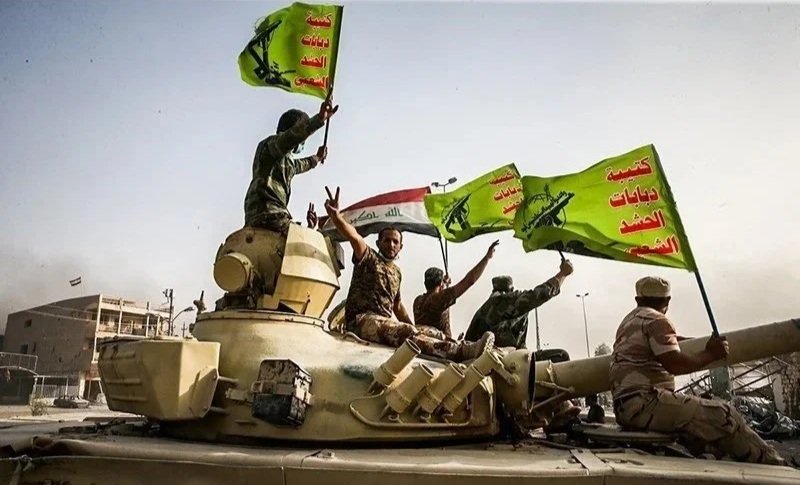
Flags of Iraq and the Popular Mobilisation Forces (PMF) are raised after the defeat of fighters for the Islamic State of Iraq and the Levant (ISIL) in Fallujah, 28 June 2016
Photo: Mahmoud Hosseini/Tasnim News Agency
The politics of disarmament
The challenge is not simply one of disarmament. Beyond its military role, the PMF provides salaries, pensions, and welfare benefits to large numbers of fighters and their families. Scenarios envisioning the dismantling or downsizing of the organisation therefore involve difficult questions of employment, social protection, and political patronage. This helps explain why reform proposals have generally focused on further institutionalisation rather than dismantlement, offering greater oversight and clearer chains of command while preserving the benefits on which many PMF constituencies depend.
The armed group assimilation dilemma
Integration is attractive to many PMF factions only if it preserves their political influence, access to resources, and a degree of organisational autonomy. Groups that believe they can shape ministerial appointments, budgets, and security policy may view deeper integration as a viable path forward. Others fear political marginalisation and the loss of hard-won influence. As a result, public statements expressing support for integration often remain deliberately ambiguous, leaving room for continued bargaining over the future distribution of power within the Iraqi state.
Ideological beliefs should not be considered to have been bombed into insignificance. For many PMF factions, armed resistance remains central to their identity and legitimacy. Debates over integration are therefore not simply about power and resources, but also about each faction’s distinct transnational loyalties and ideological beliefs.
“Attempting to dismantle an organisation that provides employment, welfare, and political representation to large numbers of Iraqis risks generating resistance and instability”
The way forward for security sector reform in Iraq
A viable reform strategy is unlikely to succeed if it treats the PMF primarily as a military problem. The organisation has become deeply embedded in Iraq's political institutions, welfare systems, and patronage networks. Any attempt to reduce its autonomy must therefore address not only weapons and command structures, but also the social, economic, and political functions that the PMF performs.
This points towards a gradual process of institutionalisation rather than abrupt disarmament. Reform efforts should focus on strengthening state oversight, clarifying chains of command, harmonising salaries and benefits, and expanding mechanisms of political and judicial accountability. The objective should be to create incentives for factions to comply with the military chain of command in exchange for preserving a meaningful role within state institutions, instead of ignoring or rubber-stamping their autonomous military capabilities.
Such an approach will not satisfy those seeking rapid disarmament. Yet the alternative – attempting to dismantle an organisation that provides employment, welfare, and political representation to large numbers of Iraqis – risks generating resistance and instability. The more realistic path is to continue shifting the balance of power within the PMF while gradually restructuring constituent brigades with particular resistance histories. For many PMF factions, that transition may be more attractive if it offers greater institutional authority in return for reduced military autonomy. The central challenge for Iraqi policymakers is how to accelerate that process without undermining the fragile political settlement that underpins their influence.
Dr Inna Rudolf is Fellow at the Centre for Statecraft and National Security, Research Fellow at the Centre for the Study of Divided Societies, and Research Fellow on the Cross-Border Conflict Evidence, Policy and Trends (XCEPT) research programme, at King’s College London. Her new book, Iraq's Shi'a Warriors: From Battlefield to Parliament, was released by Manchester University Press in April 2026.
The research on which this analysis was based was conducted under the XCEPT project, funded by UK International Development. Inna's other work under the XCEPT project can be found here.