
Why female fighters' wartime gains rarely survive the peace

Wars that mobilise women in large numbers are often assumed to lay the foundations for more gender-equal societies. But as Centre on Armed Groups Fellow Hilary Matfess argues in her new book, After Liberation: Women and the Politics of Expectations in Rebel-to-Party Transitions, the evidence says otherwise. Instead, postwar politics often produces a sharp reversal, as former rebel movements moderate and return to “normal” politics (and pre-war gender roles).
We spoke with Hilary about why rebel movements so often abandon wartime promises to women, what the Tigray People’s Liberation Front (TPLF) and post-Assad Syria reveal about postwar gender politics, and what policymakers and peacebuilders should do differently in an era of intensifying patriarchal backlash.
One of the most striking findings in After Liberation is that high wartime female incorporation does not reliably predict postwar gender progress. Groups with large numbers of women combatants, gender-egalitarian rhetoric, or formal women’s wings are not, on average, more likely to deliver gender-progressive outcomes after war. Why is that?
That counter-intuitive finding is what makes researching these dynamics so interesting — and so urgent. In After Liberation, I argue that armed groups that transition to political parties face a different set of political incentives after that transition. After war, there is this huge push for a return to normal, and that’s connected (implicitly or explicitly) to a return to the pre-war gender relations. So while armed groups might have benefitted tremendously by mobilising women during war (both from women’s actual contributions and from the ideological implications of mobilizing everyone to the fight), they often face pressure to moderate and become reasonable politicians after war. All too often, that means reneging on the promises they made to women during war.
“It’s critical to acknowledge that women are not a monolith — and that efforts to empower women in general can end up creating or reinforcing oppressive hierarchies that benefit a narrow subset of women”
You describe postwar patriarchy not as a sudden reversal, but as patriarchal kudzu, something that creeps over, and gradually suffocates, wartime gains. That image helps explain why many women veterans describe frustration, marginalization, or disappointment that mounts gradually, rather than in a single moment of betrayal.
What are the early warning signs that this process is taking place – that the kudzu is swallowing women's gains? And is it possible to push back against the kudzu?
I grew up in the American south, where kudzu is this sort of omnipresent force, marching inexorably forward along I-20. While I was trying to think of how to explain patriarchal resurgence, I remembered how baffling and unnerving it was to drive past the same spot and see only a sort of outline of what had been there last, now covered in kudzu. I think it’s a useful metaphor because many people — academics, policy-makers, interested observers, donors — all want to know who is to blame or what went wrong that leads to women’s post-war marginalisation.
I think that it’s probably most helpful, in this political climate at least, to work on making sure that women’s issues stay on the agenda and that the threat of patriarchal resurgence is constantly emphasised. As with any early warning system, predicting how and where patriarchal kudzu is going to crop up is difficult. The intensity of the patriarchal backlash and its targets are going to vary from context to context, so there is a real risk of just handing out a check list and saying that the problem is solved if we just tick off the boxes.
My strongest advice would be to consider the incentives that former-rebel parties face and how they have shifted from war to peace. Are there opportunities to make it politically viable for them to continue certain gender-egalitarian policies or practices? Where are they facing the greatest pressure to moderate? Are there any women’s wings associated with the party that can help push these matters forward? It’s also critical to acknowledge that women are not a monolith — and that efforts to empower women in general can end up creating or reinforcing oppressive hierarchies that benefit a narrow subset of women.
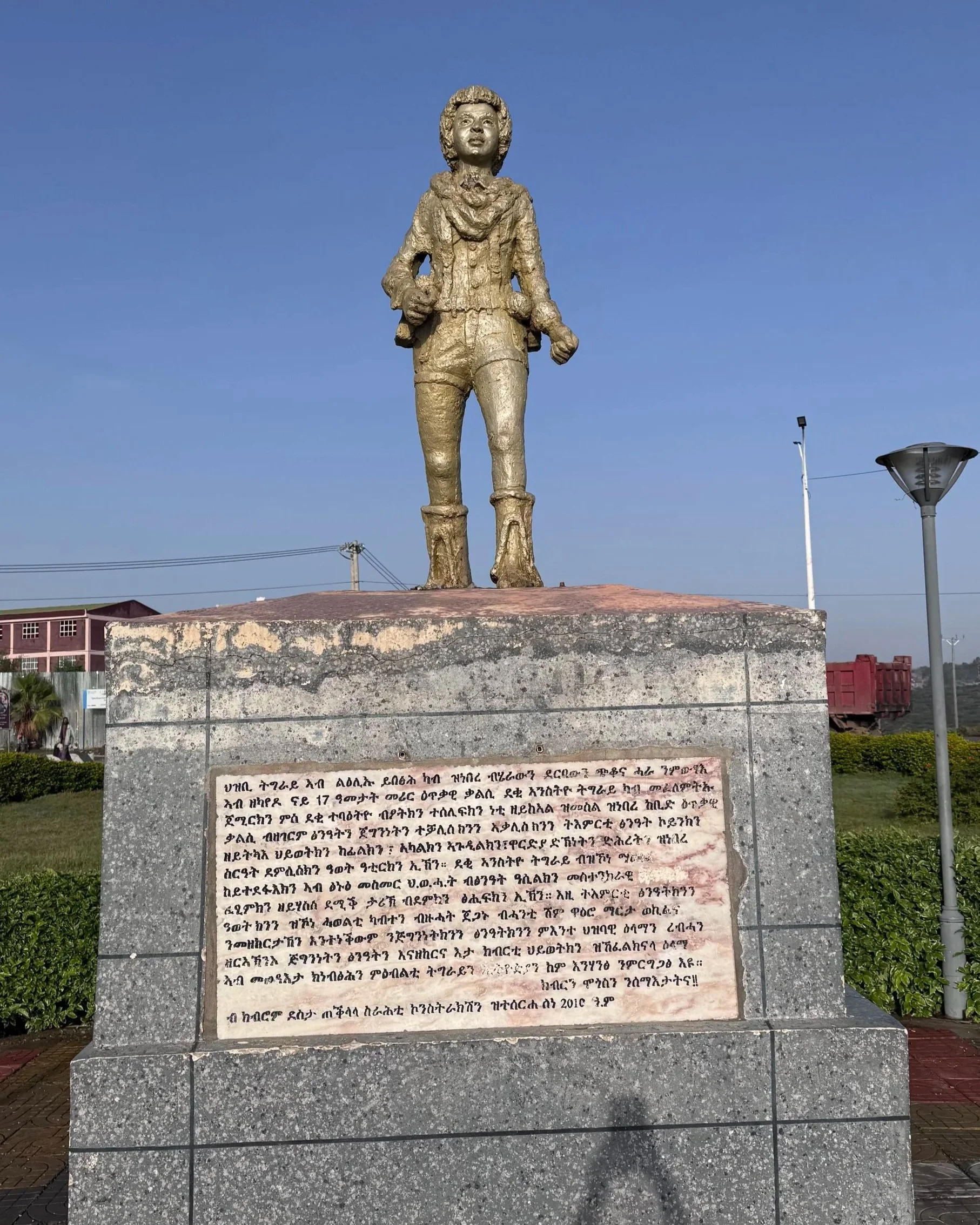
Statue of “Marta” in Marta Square, Mekelle, built 2018. Marta Mebratu was an Ethiopian-Eritrean revolutionary who was a strong proponent of women’s participation in armed struggle for liberation, as part of the student movement in the 1970s that precipitated the Ethiopian revolution. Marta was killed as she attempted to hijack a commercial airline in 1972, and went on to be seen as a martyr. Many women TPLF fighters later used the nom de guerre Marta during their resistance campaign against the Derg regime through the 1970s and 1980s, as referenced in the statue’s inscription, which pays tribute to all Tigrayan women fighters. Photo taken in the wake of the Tigray war, and the word ‘Ethiopia’ can be seen scratched out twice, when the text refers to TPLF sacrifice for the wider country, reflecting changing dynamics of the contemporary armed conflict. (Image credit: Hilary Matfess)
Of all of the case studies explored in the book, Rwanda most sharply tests your core argument. The RPF recruited relatively few women during the war, and did not rely heavily on gender-egalitarian wartime propaganda. Just fourteen years after their victory, Rwanda became the first country in the world to have a female-majority parliament. What does Rwanda tell us?
Yes! I am actually working on a book chapter now comparing the TPLF and the Rwandan Patriotic Front. I think that the Rwanda case is so interesting because it shows us how groups that did not include women in massive numbers or in especially gender deviant ways might actually have more leeway to promote women after war.
In that book chapter, I’m playing with ideas about how groups’ wartime inclusion of women shades how their post-war inclusion of women is viewed. So while Rwanda could gender-wash its regime and cultivate a reputation as a donor darling by including large numbers of women in public life, the TPLF might have been viewed as radical for doing so in the immediate post-war period.
There’s also a broader question at play here, which is whether the argument that I present in the book applies to groups with more conservative and even retrogressive gender norms. I think that it does! Think about the Hay'at Tahrir al-Sham (HTS) in Syria. After deposing the Assad regime, HTS took control and appointed a female cabinet member and put a number of other women in visible, public leadership roles. A number of folks more familiar with Syrian politics than I am argue that this was a way for the HTS to soften its international image — so their inclusion of women reflected the change in the incentives they faced in the shift from warfighting to governance.
“Gender equality went from being considered a normatively desirable good to being considered a distraction from the ‘real’ work of peace and security”
One takeaway from the book is that we may have been asking the wrong question in the first place. Instead of looking at women’s participation in war, perhaps we should be thinking about whether postwar political institutions actually create incentives to protect or deepen the gains women made during conflict.
What should policymakers, mediators, and peacebuilders do differently, if they are to take that change seriously?
This is such a great question and it’s so difficult to answer because we are living in an era of acute patriarchal backlash. It’s been difficult for me to wrap my mind around how quickly gender equality went from being considered a normatively desirable good to being considered a distraction from the ‘real’ work of peace and security.
In an ideal world, I would love for policymakers, mediators, and peacebuilders to question their assumptions about the inherently peaceful nature of women and take from this book a better understanding of how to support female ex-combatants as they navigate post-conflict politics through intersectional and feminist program design and implementation. I fear that’s not the world we’re living in. Hell, at least three of the words above are functionally banned by the US government at this point.
So, thinking realistically and acknowledging that there just isn’t a ton of political will to implement gender-sensitive post-conflict programming, I have to moderate my expectations. And so I would hope that readers recognise that failing to take women’s experiences during and after war into consideration seriously isn’t just detrimental for women’s rights and representation. It also undermines our understanding of conflict and post-conflict dynamics.
I very much see After Liberation as a gendered and feminist account — but one that helps us better understand how political parties themselves operate in post-conflict contexts. Even if you are uninterested in women’s lives (which I find troubling for other reasons…), you could still learn something from the book because gendered analysis itself is a useful tool.
Hilary Matfess is Assistant Professor at the Josef Korbel School of Global and Public Affairs at the University of Denver, and Fellow at the Centre on Armed Groups. Her new book, After Liberation: Women and the Politics of Expectations in Rebel-to-Party Transitions was published by Stanford University Press in March 2026 and is available here.