

Beyond the ‘rebel’ territorial trap: checkpoints in Myanmar
This Working Paper asks: what are the governance strategies and technologies that armed groups use to project authority? Comparing the use of checkpoints by two armed groups that operate in overlapping areas in Myanmar’s borderlands, Centre-fellow Tony Neil and Saw Day Chit find that armed groups use checkpoints differently to achieve different outcomes that are shaped by underlying ideological and cosmological foundations.

Drivers of ISKP recruitment in Afghanistan
The Islamic State Khorasan Province (ISKP) has proved to be remarkably resilient despite international and Taliban government efforts to destroy it. This paper offers an in-depth analysis of ISKP’s recruitment strategies, the varied experiences of its members, and the group’s operational dynamics across Afghanistan.

Dead-end dictatorship: roadblocks, rural livelihoods and resilient resistance in post-coup Myanmar
Following Myanmar’s February 2021 coup, checkpoints have exploded, crucial to both the military junta and resistance forces. Based on fieldwork in Sagaing Region and Chin State in 2022-2023, this paper by Gerard McCarthy and Kyle Nyana theorises the relational dynamics at and between their respective checkpoints.

Resist, negotiate, submit? Civilian agency and jihadism in Central Mali
This paper examines life under jihadist groups like JNIM in Mali, looking at the different survival strategies civilians employ.

The Gaza effect: how the Israel-Hamas war is shaping armed group behavior and the prospects of engagement
This rapid analysis look at the impact of the the Israel-Hamas war on the behaviour of armed groups, and constraints on engaging with them.

Citizens without states: the implications of non-recognition for people in de facto states
This paper examine the impact of non-recognition of de facto authorities on the people living in these territories. Arguing that the negative social, economic and well being impacts are profound, it urges for a re-think approaches to de facto authority.
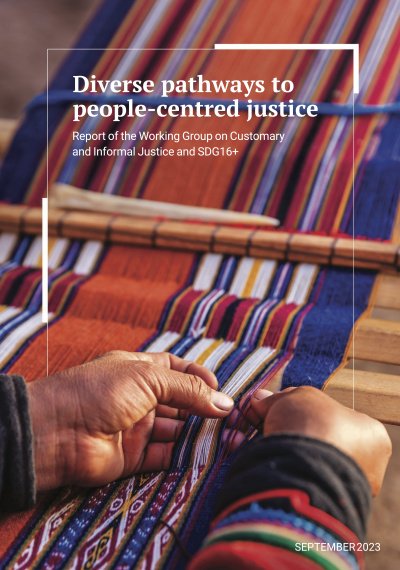
Diverse pathways to people-centred justice
Globally, most people do not resort to formal justice systems to address their justice problems. Rather, they rely on diverse pathways to justice often referred to collectively as “customary and informal justice.” Published by IDLO on behalf of the Working Group on CIJ and SDG16+, of which the Centre is a member, this report highlights the need for more people-centered approaches to justice.

Playing the long game: exploring the relationship between Al-Shabab and civilians in areas beyond state control
Based on extensive research in Al-Shabab controlled areas of Somalia, this paper explores dynamics between Al-Shabab and those who live under their control.

Taliban arms management practices
This paper argues that we should not see ‘political’ and ‘criminal’ groups as separate categories. Instead, we should envision a spectrum of motives and practices across all armed groups, regardless of how they are labelled.

Crime and communities: life under criminal group control
This paper argues that we should not see ‘political’ and ‘criminal’ groups as separate categories. Instead, we should envision a spectrum of motives and practices across all armed groups, regardless of how they are labelled.