
Afghanistan: the collapse of the roadblock state
This paper by David Mansfield examines how control over Afghanistan’s roadblocks and border crossings shaped the political economy of the Afghan Republic and contributed to its collapse in 2021. It shows how the country’s extensive trade routes became sources of revenue and patronage for government officials, provincial powerholders and the Taliban, with control over strategic points along major highways often more important than control over territory. Drawing on more than 1,200 interviews, high-resolution satellite imagery and geospatial data, the paper maps trade flows and estimates the revenues generated at key roadblocks. It challenges the emphasis on drugs and minerals in accounts of Taliban financing, showing that taxation of everyday goods transported along Afghanistan’s main roads generated substantial revenues.
Checkpoint governance in South Sudan
This paper by Joshua Craze and Ferenc Dávid Markó examines the role of checkpoints in South Sudan’s political economy, challenging the view that they are simply obstacles to trade, humanitarian access and state reform. It argues that checkpoints are a central form of state authority in a country where government salaries and public services are limited, oil revenues have declined and humanitarian funding is increasingly uncertain. The paper shows that rather than representing state failure, checkpoints reflect the longstanding predatory character of state power in South Sudan, with communities themselves sometimes adopting similar systems to resist elite extraction.
This paper is the 16th in a working paper series on Roadblocks and Revenues, a collaboration between the Danish Institute for International Studies, the International Centre for Tax and Development and the Centre on Armed Groups.

A Fracturing Order
This discussion paper examines how the international order that once contained armed conflict is fracturing across multiple, simultaneous dimensions. Drawing on cases spanning Sudan, Myanmar, Yemen, the Sahel, and Ukraine, the paper argues that these compounding failures have given armed groups and de facto authorities far greater freedom and resources than most analysts anticipated.
The paper identifies four cross-cutting dynamics reshaping this landscape: the breakdown of the classic patron-proxy model into fragmented, multi-patron brokerage networks; the growing economic and infrastructural power of armed groups, who now govern revenue streams, trade routes, and services independent of external backers; the retreat of international norm enforcement in favour of local, informal bargaining; and the weaponisation of misinformation to derail negotiations and access agreements. On this basis, the paper calls for a fundamental shift in how donors and practitioners approach engagement.
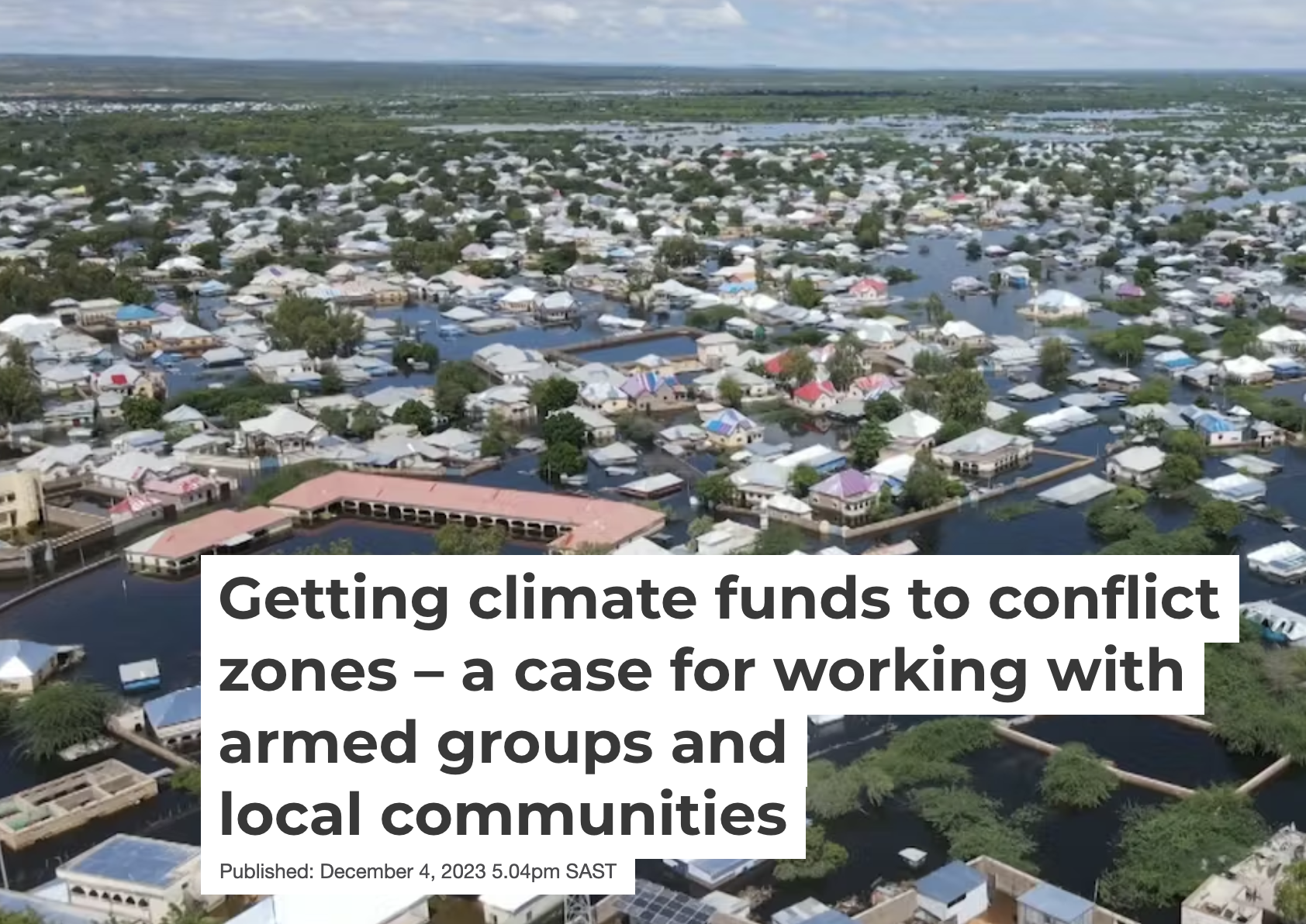
Transferring climate funds to conflict zones
Conflict-ridden and fragile countries are among the most vulnerable to climate change and least prepared to deal with it. They are largely excluded from climate adaptation programmes and funding. This article charts a path forward on how to address climate adaptation in conflict zones.

Resist, negotiate, submit? Civilian agency and jihadism in Central Mali
This paper examines life under jihadist groups like JNIM in Mali, looking at the different survival strategies civilians employ.

Climate adaptation in no-man's land: bridging the conflict-climate gap
This paper examines climate change and armed groups, specifically the failure the address climate adaptation in areas beyond state control.

The Gaza effect: how the Israel-Hamas war is shaping armed group behavior and the prospects of engagement
This rapid analysis look at the impact of the the Israel-Hamas war on the behaviour of armed groups, and constraints on engaging with them.

Citizens without states: the implications of non-recognition for people in de facto states
This paper examine the impact of non-recognition of de facto authorities on the people living in these territories. Arguing that the negative social, economic and well being impacts are profound, it urges for a re-think approaches to de facto authority.
Diverse pathways to people-centred justice
Globally, most people do not resort to formal justice systems to address their justice problems. Rather, they rely on diverse pathways to justice often referred to collectively as “customary and informal justice.” Published by IDLO on behalf of the Working Group on CIJ and SDG16+, of which the Centre is a member, this report highlights the need for more people-centered approaches to justice.

Playing the long game: exploring the relationship between Al-Shabab and civilians in areas beyond state control
Based on extensive research in Al-Shabab controlled areas of Somalia, this paper explores dynamics between Al-Shabab and those who live under their control.